By Jeni Bell.

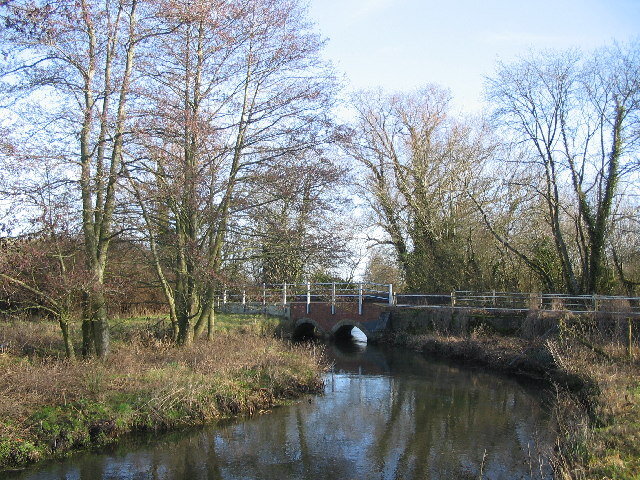
The River Ebble. Photo: Peter Facey.
We have some impressive water courses here in the UK. Fast flowing rivers, slow snaking ones with wide banks and tangled weeds. Long straight stretches of canals, and the smaller tributaries like arteries, trickling towards the sea. It seems as though here in the UK, there is a body of water to suit all moods and preferences. There is always a waterway to wander along.
My favourite of all of these is a smaller, quieter, shallower one. It talks in silvery whispers over beds of gravel and is clear and crystalline in its travels. For me, it is the chalk streams and rivers that give the UK’s aquatic habitats that magic touch. Just this morning I wandered along the banks of the River Ebble; a secretive chalk stream that weaves its way through the Chalke Valley in Wiltshire. Through a space in the reeds, I watched a little egret wade through the shallows in search of small fish and insects to feast on. And I lost nearly a whole morning to the spell the water had cast.
It can be hard to pin-point what it is that makes them so bewitching. Is it the chance encounter of a kingfisher pulsing across the surface? Or perhaps the swish of a fish tail in the shallows? Perhaps it is that some are winterbournes; summoned by winter rains. It could be either of these things and a million more. But perhaps its magic lies in its rarity.
The World Wildlife Fund (WWF) explain on their website that, “there are only about 200 chalk streams in the world, and most of them are in the southern half of England (with a few in France).” As someone who has grown up alongside the River Test and the Itchen in Hampshire, then moved to Wiltshire where I regularly walk alongside the Wylye, or pass over the Avon, I had naively never considered the rarity of this habitat. So now, on my stream-side strolls, I make a conscious effort to notice not just the river, but how lucky I am to be in its presence.
River Wylye. Photo: Phil Williams.
As well as being rare, these lowland streams are diverse. Bullheads, brook lamprey and the impressive Atlantic salmon choose to breed within the water’s gravel beds. Brown trout make their home in these clear waters, which in turn encourages a steady flow of fishermen in hot pursuit. They tie flies to replicate the ones that dance above the water’s surface. But I don’t think any strands of cotton or string do justice to the fae-like mayfly that swarms the river in early summer. Lace wings and long tails summoned by river gods themselves.
Come Spring and Summer, dragonflies and damselflies visit the delicately frothing flowers of water crowfoot tumbling through the mid channel. Here, along the Ebble, the rich green of watercress and bur-reed is punctuated with the brightness of yellow flags. All this vegetation flourishing, in the stream itself, and along its banks, makes perfect hiding spots for more conspicuous creatures, such as otters and other mammals. I’ve often heard the small splash of a water vole diving into the water, but on turning to look there is no plump-bodied rodent to be seen. It’s as though a disappearing act has been staged.
All these living beings are attracted by the clarity of the river and its ability to maintain an almost constant temperature (which I can assure you, from many a river dip, that temperature is consistently cold). The reason for its clearness almost seems like magic in itself. Conjured up from underground aquifers, and as the stream grows from a spring into something more substantial, the chalk is always working to filter and purify the water. That (and its shallowness) is often the reason you can see down into their depths.
This in-inbuilt infiltration system doesn’t grant these globally important waterways immunity though. They do not have enough spells and rituals to guard them from pollutant run-off, or from over-abstraction due to increased water demand. Although it will eventually be naturally replenished it is not instantaneous, and that deficit will leave fish floundering, aquifers dry, and vegetation un-watered. If we don’t care for this aquatic ecosystem, we are at risk of losing one of most magical habitats.
I don’t think it’s any one thing that gives a chalk stream its magic charms. It’s not solely down to the flash of a kingfisher, or the water’s ability to constantly regenerate itself. I wouldn’t say that it’s just the watercress, or the iridescent wings of a damselfly. Or even the fact that it is especially rare. It’s magic flows from all these things combined together. Seen and unseen. Just walk a little way along the banks of one, and you’ll see exactly what I mean.

Find more from Jeni:
Our Curlew range has recently expanded! Take a look at the full range below.
10% of the sale price of all curlew products is donated to Wildfowl and Wetlands Trust.

Our spiral bound Creature Candy notebooks are A5 sized, and ideal for keeping on your desk or in your bag. Featuring a beautiful hand drawn image of an Eurasian curlew Numenius arquata, this notebook is perfect for to-do-lists and journal notes.
50 lined sheets. Printed on FSC certified paper.
Designed and made in England.
10% of the purchase price will be donated to the wildlife charities we support.

Seconds items, with very minor marks.
A stylish soft grey Creature Candy melamine placemat featuring a beautiful hand drawn image of a curlew Numenius arquata.
Designed and made in England.
Dimensions: 28.2cm x 20.5cm. Cork backing.
10% of the purchase price will be donated to the Wildfowl & Wetlands Trust.

Keep in touch with your loved ones with our range of Creature Candy greetings cards. This card features a beautiful hand drawn image of a curlew Numenius arquata. Cards are A6 size, blank inside and come with a light grey envelope.
Printed on FSC certified paper.
Designed and made in England.
10% of the purchase price will be donated to the Wildfowl and Wetlands Trust.
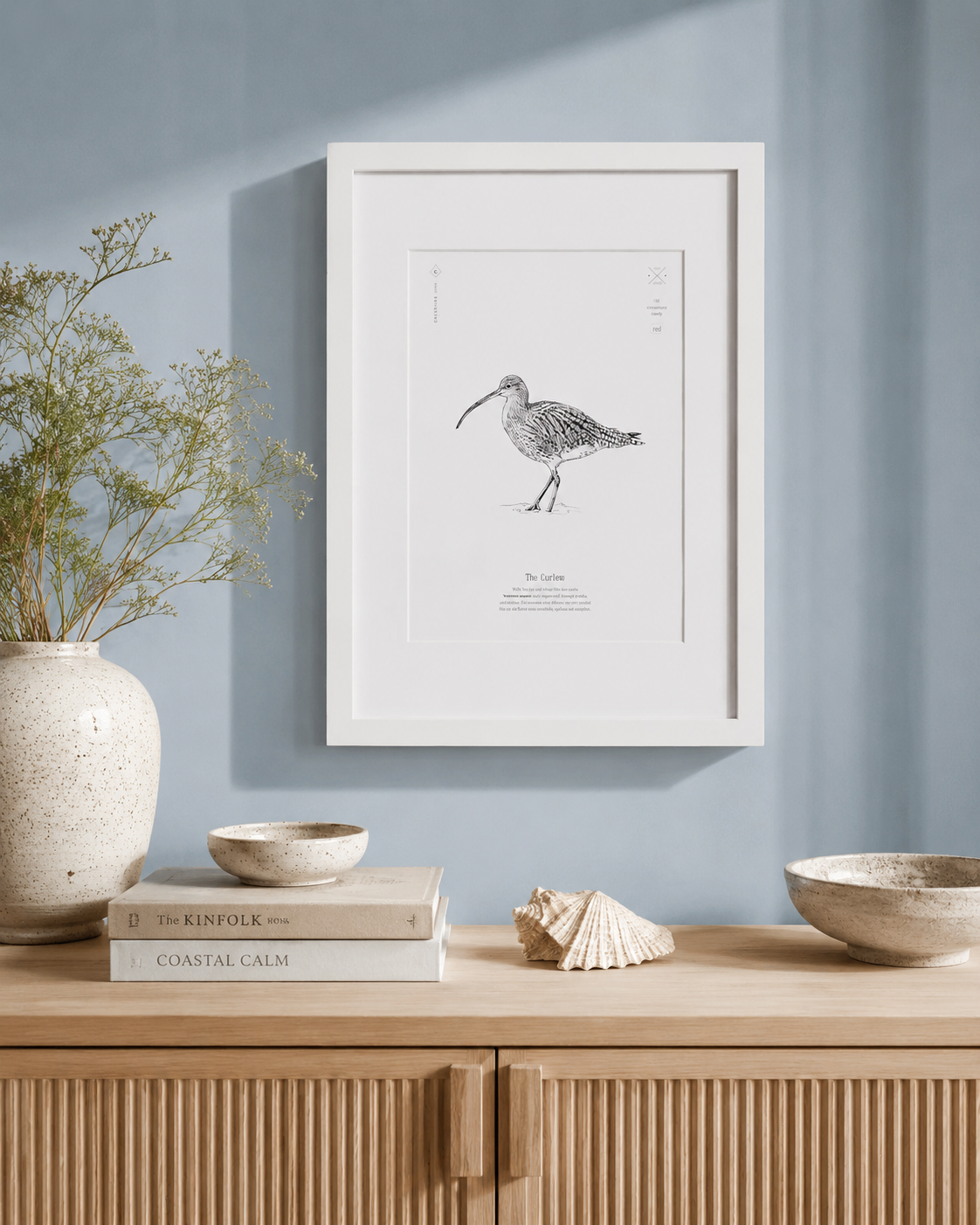
Invite nature inside with our Creature Candy print featuring a beautiful hand drawn image of a curlew Numenius arquata. Each print is presented on textured paper, giving the image a sense of depth and realism.
Available in A4.
Designed and made in England.
Prints are unframed and printed on FSC certified paper.
10% of the purchase price will be donated to the wildlife charities we support.